"You can teach students one lesson a day; but if you can teach them to learn by creating curiosity, they will continue the learning process for as long as they live." ~ adapted from Clay P. Bedford
Showing posts with label Mini Lesson. Show all posts

Monday, November 1, 2010

Setting the Tone

It's been a while since I've discussed any of the other mini lessons that weren't my own. This is a real shame because my fellow teachers have put a lot of effort into their mini lessons and have provided us with a lot of great ideas and resources that we can use in our own classrooms.

On Monday November 1, Lindsey did a fabulous lesson on "TONE". She started by having us write a little paragraph about a topic that we really liked. As we were writing, she stipulated that we couldn't say "I really like this because...". We had to convey our feelings about the topic through the implied tone in our writing. She then had us write about the same topic as though we hated it. The same stipulation, (that we couldn't say, "I hate this because") was still in play. This exercise was fabulous and a great way for the teacher to evaluate what the students already knew about the topic of tone. Because we weren't allowed to directly say, "I like/hate this topic because" we had to resort to other words and phrases that conveyed the same meaning.

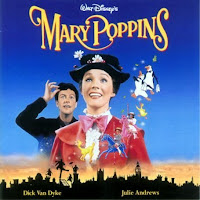
Lindsey then showed us two "spoof" trailers: one for The Shining and the other for Mary Poppins. These trailers were created using a different tone; let me explain, The Shining is known as a horror film and the original trailer depicts the film as such. The spoof trailer, created using a happy tone, made the film look as though it was a heart-felt family comedy. Mary Poppins is a beloved children's film; however the spoof trailer makes it look like a horror film. Lindsey successfully integrated technology into the classroom and relevantly emphasized the importance of tone through visual media.

Her final activity was a group activity where each group was given a word that describe a certain tone (example: love); she also gave us a topic: taking your dog for a walk through the park. In groups we had to write a paragraph/short story that expressed this tone and the rest of the class had to guess the tone word.

Describing tone and getting students to  actually understand the implications and importance of tone can be difficult - it's one of those secondary elements that is usually passed over or simply ignored. From personal experience I find that teachers overlook tone because it's already evident in their students writing. They do not take the time to actually explain it; nor do they take the time to express the importance of tone to their students. Tone is fairly instinctive and natural - if you are angry about something, you will write in an angry tone; if you are happy about something, you will write about it in a happy tone. It's unfortunate that some teachers abuse this unconscious ability to add tone to a piece of writing and skip over the topic.

Other mini lesson's I've missed:

Symbolism in To Kill a Mockingbird
This lesson introduced the many symbols in the classic novel, To Kill a Mockingbird. The lesson began with the opening scene from the 1962 black and white film To Kill a Mockingbird. As a class we discussed the various symbols and their possible meanings; then in groups, we read a few key passages from the novel and discussed key symbols and their implications.

Introduction to the Persuasive Essay 
This lesson was really interesting. It began with the class being divided into half - pro and con. In our groups, depending on what side of the room we were on, we had to debate whether students should be given homework. Individually, we had to come up with reasons that supported our side of the debate. Then as a group come up with our "argument" and present it to the class in a classic debate situation. This was a really great way to have students stick to one point of view. The question was very relevant to students and was one that the students could argue. For "homework," students had to write a persuasive paragraph that argued the opposite side of the argument.

So far the mini lessons have been really great and really informative. With each new lesson, my resource package for teaching various topics in English is growing. I am thankful for my colleagues and their willingness to share their ideas. The class environment we have created is solid and supportive - we are, after all, in this together.

Until next time,
LC

Thursday, October 21, 2010

Day 8 - Last Day

Well Ladies and Gentlemen,

The last day of observation is over. I'm almost saddened because I didn't get a chance to see a lot of the teachers that were recommended to me. I've had a fabulous experience and I definitely don't want it to end. I must admit this is partly because now I have to write an eight page paper due Monday, an Observation Journal due Thursday, write a quiz and get back to being a student.

My last day at Collingwood was amazing. I started the day by teaching a lesson on "the THESIS" to a grade ten English class - the lesson went brilliantly. On Monday's class the students were given their assignment. They had to write an essay on "Remembrance." Talk about BROAD! It's a completely open essay in that they can write any type of essay they want, on any topic they want so long as it relates to "Remembrance." While you may think that this is a great opportunity for the students to write whatever they want, without clear direction students were having terrible time getting started. For homework they were supposed to bring their introductory paragraph and one of their body paragraphs to class. I took this opportunity to address the thesis statement. As an entrance slip I had the students provide me with their thesis statement. After several thesis building activities I gave their theses back to them and had them evaluate their own work. The response of "wow, my thesis sucks" was very popular. I then gave them time to edit their thesis statements and then had them share them. As an exit slip they had to give me both their original thesis statement with the new one underneath it.

Before doing the exit slip though, I made sure to ask them what the lesson was and I had them give me feedback about what I needed to work on as a teacher. They were super great and super polite. Based on their feedback they not only understood the lesson, but understood how to fix their own work. I'm going to take this as a good thing.

The rest of my day went well. I simply observed the last few classes that I could and made sure to take a lot of notes. I went to English 12, Biology 12 as well as a Law 12.

Overall my experience at Collingwood has been a memorable one. I've included a picture of my schedule and classes I've observed, hopefully they are legible - if you want to see a larger more clear view, just click on the schedule.


Legend:
MS = Middle School
SS = Senior School
Anything in RED I was not at the school because of Thanksgiving, Pro-D days or otherwise.
Anything in Green is a School wide event (Ex. Break and Assembly)

See you back on the rock,
LC

Thursday, September 30, 2010

EDCI 747 Mini Lesson

Today I presented my mini-lesson on William Shakespeare's Romeo and Juliet. For the most part I thought it went well. When I woke up this morning I was extremely nervous, but by the time I got to class I was more frustrated than anything else. Usually I can leave my house and make it to the bus stop in five minutes, get on the number 14 bus and make it to school within 15. It makes sense then that I can leave my house at 9:30 to make my 10:00 class. Unfortunately today, on my presentation day, the number 14 bus decided be late, crowded and super frustrating. Two buses, both extremely full, drove passed me making me late for my class. I was not impressed. I ran to class carrying a very heavy back-up and poster board trying to be less than 5 minutes late. When I finally arrived to class, it had already started so I quietly slipped in and while Barbara was talking I set up my lesson.

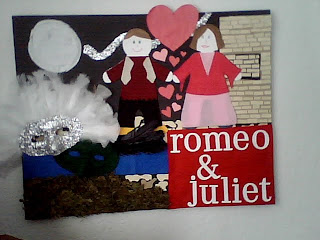
The rest of the lesson went off with out a hitch. I did forget to do a couple of important things, but overall I think the class had fun. I started by introducing Romeo and Juliet through a poster board:
The goal behind an introduction board is simply to give the students the chance to visualize the characters, and perhaps introduce the setting etc. It's a starting point. From here you can ask the students about what they already know about Romeo and Juliet, what the board suggests is going to happen and so on. You can also give brief descriptions about the basic plot as well as a history of Shakespeare.

My lesson (which was supposed to be only 15 minutes) attempted to focus on the language of Shakespeare and getting the students engaged with the text. I started with an insult activity where the students were given a "Shakespeare Insult Kit" - this can be found online, just click here! They would move around the room, bump into each other, and throw out an insult. The purpose of this activity was to demonstrate that Shakespeare can be fun and not so serious. Based on the feedback that my colleagues gave me, the insult activity was a great success. One colleague said, "The insult sheet is brilliant. I think it really diffuses the cumbersome language and the activity allows students to have to fun with Shakespeare before they have even read the play." So take note! Insulting someone can be a good thing :)

From there I moved on to the prologue and read it several times. Again, the goal was simply to get the language flowing from the students mouths. I got mixed reviews about this activity; some colleagues liked it and thought that each reading had a purpose and was useful, while others thought it was drawn out and possibly not the best way of going over the prologue to R&J.

After this activity I complete forgot to actually go through the prologue and define any words that the students might be confused about and what the prologue was about. I moved too quickly into the next activity which was a hand out that had lines from the play and had the students translate the lines into modern language. As soon as I said "go" I thought to myself, "How in the heck are grade 9's going to do this without practice before hand?" Oh well. Some of my colleagues actually called me out on this in their feedback and I appreciate it greatly. I also forgot to draw attention to another great resource that I included on the hand out. I found a "Shakespearean Dictionary" online (click here) that could be helpful to students of all ages.

Almost every one of my colleagues commented on my energy and enthusiasm - I'm going to take this a plus since I was nervous, but didn't show it :)

It was a great learning experience and now I know what to work on for next time. Thanks for the great feedback! And feel free to comment here too.

Until next time,
LC

Monday, September 27, 2010

Another Week has Gone by....

Tomorrow marks yet another week gone by. I can't believe we're in the final week of September and two weeks away from our observation period. I'm so excited to get out there and actually be a part of a different school community; I'm so excited to get out there and observe and learn from teachers already in the field! I can't wait to actually get out there and experiment with all of the teaching strategies and techniques we've discussed in my classes so far.

EDCI 747 with Barbara

This past week in EDCI 747 we focused on Grammar and learned about the "Stations" technique. As well, Chris gave us a mini lesson on poetry (my least favorite part of English). I honestly don't know how he did it, but he managed to make poetry a little more fun for me. I think it had to do with the activity he made us take part in. He split us into groups and gave each of us a line from a particular poem; as a group we had to put the poem back together. While this could be disastrous and hilarious at the same time, both groups managed to put the poems back together. The interactive nature of the activity created an atmosphere of "fun-learning." If that makes sense. :)

Also this week, a different Chris gave us a little mini lesson on novels and the implications of their covers. The activity he chose was great. He divided the class into groups and gave each group a piece of paper with two covers on it (five different covers total) and had us come up with words and phrases that described the covers. The titles and authors were left blank so we literally had to judge a book by it's cover. We shared our ideas and found out that the five covers he gave out were actually all the same book. Interestingly there was only a small amount of overlap between the phrases and descriptions and when it was revealed that the covers were all the same book we were shocked. Moral of the lesson: don't judge a book by it's cover.

My mini lesson takes place on Thursday - I've very nervous and I'm sure you'll find a blog post about it soon.

EDCI 373 with Dawn

I haven't talked about EDCI 373 before because I feel weird and awkward talking about it. However, if I'm to believe that we are all entitled to our opinions then I guess a blog is a great way to voice that opinion. EDCI 373 is the new required Indigenous Education class. Our teacher, Dawn Smith, is Indigenous and so far she's been great. We've had discussions based on readings, we've had guest speakers and we even had the resident elder, Joyce Underwood, come in and welcome us by singing and dancing - it was awesome. It has honestly been a real privilege learning about the different cultures within the Indigenous community. That being said, there's something that leaves me unsettled about the class - don't get me wrong - I like the class and the readings - I just feel that the discussions we do have in class don't stretch as far as they could...does anyone feel the same way? I feel that we could be learning more. Perhaps I'm simply confused about what we're supposed to be learning. Are we supposed to be learning about the different cultures just to learn about the different cultures? Or are we supposed to be learning how to teach the subject of Indigenous Education in our Social Studies classes and address all of the controversial issues that surround Indigenous Peoples?

The next few statements are probably going to cause some people to get defensive and uncomfortable and/or angry, and I don't mean any disrespect and I don't mean to make you feel that way, but I feel like I need to address the issue. I feel that because we are mostly a "white" and "uneducated" (and I use those terms loosely - please don't be offended) group and we do not want to offend anyone, that our discussions are lacking. They do not address the controversial issues that are out there. They do not look at the racism within Canada or the world - and please don't be naive and think that racism doesn't exist in Canada because you'd be wrong. Maybe our class just hasn't gotten that far yet. We haven't discussed how to deal with issues like the integration of Indigenous students into the public school system and the bullying and racism that may go on in our own schools. We haven't discussed the possible segregation that may happen because young people are not as sensitive or understanding and welcoming as we are. I don't think we are voicing any concerns or making bold comments or voicing opinions that may be considered controversial, insensitive, or "wrong" because we're afraid to "ruffle some feathers." I could keep going, but I think I've said enough and I'll end by saying I'm sorry if I offended anyone it was not my intention at all - Forgive me? I just felt like someone needed to say it.

I think that's a lot of information for now....If anyone as any incite or can help me understand better or simply want to vent, comment away!

Until next time,
LC

Tuesday, September 21, 2010

EDCI 747 with Barbara Pelman

For many of you this entry might sounds familiar as we all appear to be in each others classes :) Please feel free to add to this entry with a comment should I forget anything.

EDCI 747 with Barbara Pelman (Mon. September 20th)

Class with Barbara is always engaging. I feel like I'm learning a lot without taking extensive notes or having to pay full attention. Does that make sense? Simply put, it's as if I'm transformed into a sponge and all the information is just being absorbed. Her activities are fun and new and nothing like my grade 12 English class was. She relays her knowledge and advice in a way that is non-threatening. She quickly established a classroom environment where we are treated like adults that actually know stuff. I guess by now this shouldn't be surprising, after all we do have degrees already, but still.

We started student mini-lessons this week and Aaron bravely went first (props to Aaron right here). His lesson focused on the graphic novel and its role in the classroom. Personally, I like graphic novels and definitely believe that they have a place in any classroom. They are not new per-say, but they are sometimes regarded as "comics" and not real "literature." However, for a student who does like to read, or simply does not read, the graphic novel could be a great way to make reading fun. Graphic novels are simply another resources to help students engage in what they are reading; basically they are a way to inspire reading. I guess the larger question, based on what we learned from Aaron, is how do we get our students to read? In an ever changing society, one that is moving so quickly, many students find it difficult to focus on a text for longer than a minute. Sitting silently and actually reading print is quickly becoming "uncool" and "uncommon." This could prove to be disastrous in an English class.

Ask yourself these questions (and please answer them in a comment below - I'm very interested to hear what you think): how many of the readings that were assigned over the last four years did you actually read? How many novels did you actually read, read well, and read on time? How many of you skimmed through this very blog to just get the jist of what I was saying? Did you have facebook open? msn? Was your cell phone buzzing in the background?

Now as prospective teachers answer me this: Why should a student read anything (ex. Hamlet) when s/he can simply find summaries and analysis' online? How do we make reading the classics cool?